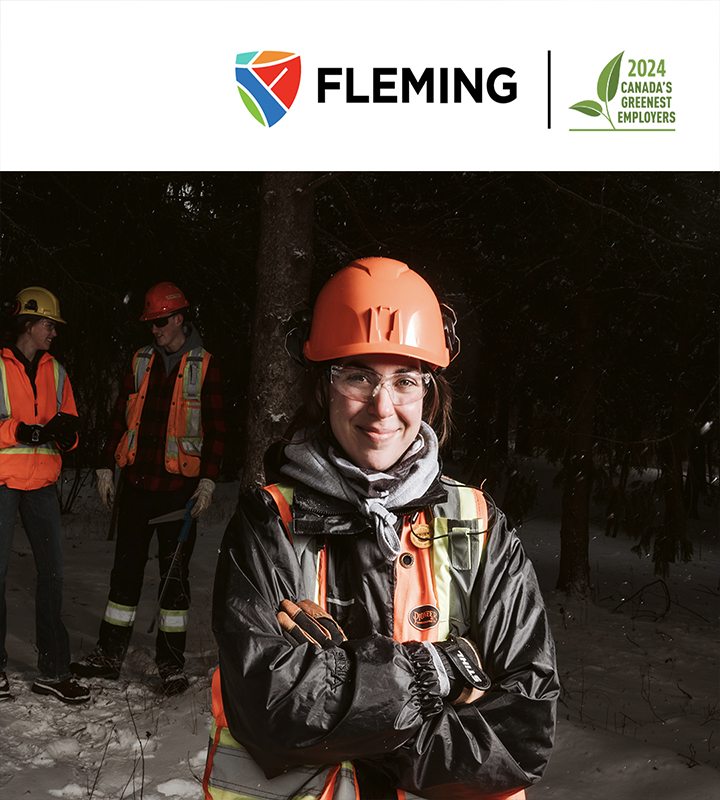
Forestry Technician

Start In:

Location: Lindsay
Program Status: Accepting applications
Program Code: FT
Co-ordinator: Gerald Guenkel
Credential: Ontario College Diploma
Classes Start: September 7, 2010
Tuition/ Fees: $1,660.75 per semester *
* Tuition and fees subject to change.

Program Highlights

Be a part of a close-knit community of men and women across the country who are making a difference in our environment as a Forestry Technician. This career path will appeal to you if you are passionate about the outdoors, and concerned for the responsible management of forest resources.


In Fleming's two-year Forestry Technician program, you'll acquire the right stuff to work effectively in natural resources management -  from identifying trees to working with high-tech computers.

Students performing a forest assessment.

  • In an ideal combination of theory and technical hands-on experiences, your studies in the classroom will be complemented by numerous field excursions.
  • You'll participate in the Forestry program's unique field camp experience.
  • In addition, you can increase your credentials (and career readiness and versatility) by taking certification courses such as forest fire fighting, first aid and CPR, tree marking and cutter certification (at a modest extra cost).

Want to gain an international perspective on forestry? Through an international exchange program, you can visit Europe for as little as three weeks or as long as one semester, attending courses at our partner institutions - the University of West Hungary, in Sopron, Hungary and the University of Padua in Legnaro, Italy. 

Word from the Workplace

"I had completed the Fish and Wildlife program, and realized that the Forestry program was an excellent complement to it. In addition, I could receive both diplomas within a three-year period. I believe the Forestry program is `leading edge' within Ontario, and provided me with the basic fundamentals and sound knowledge that I needed to succeed in this career. In some districts, geographic information systems is a fairly new concept, and the training and background I received at Fleming helped to really set me ahead in this area."

Jennifer Hughes, Program Graduate
Area Technician, Pembroke District,
Ministry of Natural Resources

Why Choose Fleming?

Three decades of producing excellent grads has the close-knit forestry industry seeking out more for new hiring opportunities every year. Our grads are now in a position to hire new grads, and are doing so as a result of their own positive experiences in the program. Fleming's Forestry program has an excellent reputation for producing top-notch, competent technicians for a wide variety of agencies, companies, and organizations. The Forestry grad is highly sought after by government ministries, agencies, and forestry companies - including, for example, the B.C. Forestry Service and the Nova Scotia government's ministries of natural resources and the environment. Employers recognize that the students' training is holistic, and prepares them for a wide variety of tasks and duties.

Common First Semester 
Students in our School’s diploma programs take the same courses for first semester after choosing and being accepted into one of our programs. This common focus exposes you to a variety of career options and other programs. You will have the freedom to explore and obtain a multidisciplinary perspective, while you acquire a base of knowledge and fundamental skills.

Although students are accepted into a specific program for their first semester, the common first semester allows you to change direction if you find another program or career area is more appealing. Once you have successfully completed the common first semester, you can enter the program of your choice in second semester, subject to enrolment capacity.

Work Experience

There are many practical, hands-on opportunities throughout the program. You'll have the opportunity to participate in our field camp, practicing your forestry skills while developing teamwork skills.

What it Takes to Succeed

Forestry Technicians are responsible for resource management planning and protection. Experience working in parks, nature centres, or similar venues, either as a volunteer or employee, would be an asset. Your success in forestry will be greatly helped if you have:

  • a passion for forests, environment, outdoors
  • problem-solving ability
  • strong organizational skills
  • good background in maths, sciences
  • willingness to move for a career opportunity

Career Opportunities

There are career opportunities anywhere there is a forest, in rural, wilderness, and urban settings. As mentioned above, major employers in the field seek to hire Fleming graduates, so there's many career opportunities straight out of college. You could find yourself working for hydroelectric companies, conservation authorities, municipalities, forest industry (woodlands, sawmills, pulp mills), government agencies, forest nurseries, federal/provincial forestry-related ministries, and private contractors both within Canada and abroad. Job titles you may hold include forest ecosystem assessor, firefighter, silviculture technician, forest technician, conservation authority technician, forest operation supervisor, and forest planner. With additional training, you could also work as a forester. There's lots of opportunities for women! Employers of Forestry Technicians are after brains, not brawn in the men and women they hire.

Minimum Admission Requirements

OSSD with the majority of credits at the College (C) and Open (O) level, including:

  • 2 College (C) English courses (Grade 11 or Grade 12)
  • 2 College (C) Math courses (Grade 11 or Grade 12) 

When (C) is the minimum course level for admission, (U) or (U/C) courses are also accepted.

Mature Students
If you are 19 years of age or older before classes start, and you do not possess an OSSD, you can write the Canadian Adult Achievement Test to assess your eligibility for admission. Additional testing or academic upgrading may be neccessary to meet specific course requirements for this program.

* Students starting in January are required to attend classes over the summer semester.

Related Programs

When you graduate from the Forestry Technician program, you can continue on for a third year in Natural Resources Law Enforcement or consider Geographic Information Systems for even more career opportunities. You might also consider doing a dual diploma, by taking another of our technician diploma programs. You can graduate with an additional technician diploma with just two more semesters of study.

Additional Costs

Plan to spend about $1,100 in the first year and $600 in the second year for books, supplies and camp fees.

University Transfer Agreements

Semester 1

College Communication Skills for Environmental Science

Course Number: COMM157

Units: 67.00
Hours: 67.00

College Communications for Environmental Science

Course Number: COMM044

This course focuses on the development of fundamental writing and speaking skills, both individually and in teams, within the context of program and work needs in the environmental field. Also, students will be required to apply and to demonstrate fundamental research skills, including an analysis of library and Web resources pertaining to program-related topics. Assessment strategies will be tied closely to other common first semester courses.

Units: 37.00
Hours: 37.00

Environmental Leadership

Course Number: NATR008

This course will enable students to develop a personal position and direct their career path within the context of the environmental and natural resource industry. An integrated, community based learning approach will be used to identify and apply a personal understanding of leadership, sustainability and community in the context of natural resource sciences.

Units: 45.00
Hours: 45.00

Applied Mathematics in Natural Resource Sciences

Course Number: MATH063

This course will enable students to apply specific mathematical concepts and acquire foundation skills important in the Natural Resource and Environmental Sciences. It is designed to complement and reinforce learning within other first semester courses and program areas.

Units: 45.00
Hours: 45.00

Ecology and Environment

Course Number: ENVR020

Learn how nature works by studying the key components of the ecosystems in the Kawartha Lakes Region. Through field and lab exploration of wild life, landforms, forests, lakes, rivers and wetlands, students will see the connections between themselves, the environment and ecosystems that surround them.

Units: 60.00
Hours: 60.00

Ecosystem Skills

Course Number: ECOS013

This course will focus on three areas of study: identification, field and lab skills. Students will identify and classify the living and non-living components of the specific ecosystems described in the Ecology and Environment (ENVR 20) course. Field skills to be developed include the ability to navigate through the natural environment and use a variety of ecosystem inventory techniques. Special emphasis will be placed on safe work habits in lab and field.

Units: 60.00
Hours: 60.00

Geospatial Techniques

Course Number: GEOM036

This course is designed around the four pillars of Geomatics: Remote Sensing, Cartography, Surveying and GIS. Students will develop entry-level skills in data capture, surveying, (computer) drafting, principles of remote sensing, air photo interpretation, and in usage of representative Geomatics-related software.

Units: 45.00
Hours: 45.00

Semester 2

Data Management for Environmental and Natural Resource Sciences

Course Number: COMP461

A complete understanding of how to use data management tools will be gained through hands on work with data from a variety of disciplines in the School of Environmental and Natural Resource Sciences. The course will cover data entry, manipulation and analysis as well as how to import/export and link data, charts and graphs to documents in various programs.

Units: 45.00
Hours: 45.00

Forest Fire Science

Course Number: FSTY012

The ecological role of fire in Canada's boreal forest is one of renewal. Many species rely on wildfires for creating conditions to favour their regeneration: this creates a rich, ecologically diverse landscape that supports many species, both tree and animal, on which economies are based. One theme of this course will be to strengthen knowledge and application of initial attack fire suppression tactics and strategies. The role of fire as a silvicultural tool (e.g. prescribed burning) will be the second major theme of this course.

Units: 45.00
Hours: 45.00

Forest Measurement

Course Number: FSTY073

This course deals with specific measurements and assessment methods for forests. The course involves laboratory sessions and field trips. Measurement of tree height, tree diameter, basal area, land area, and tree volume is studied. The Canadian Fire Weather Index system is introduced. Fixed area sampling, point sampling, tree marking, and fuel loading are field trip topics.

Units: 45.00
Hours: 45.00

Soil Studies II (Ecosystem Management/Forestry)

Course Number: NATR083

Soil Studies II course for the Ecosystem Management and Forestry Technician Programs continues with physical and chemical properties of soils and introduces the biological component required for the understanding of forest soils. The student will determine soil textures, pH; moisture regimes and drainage, identification of mineral and organic soil profiles: application of the Forest Ecosystem Classification methodology, and perform a soil/site description in the field. Throughout the course analytical skills will be developed that are typical of site evaluation and environmental studies.

Units: 21.00
Hours: 21.00

Soil StudiesI

Course Number: NATR041

The Common Lecture/Lab portion of the Soil Studies course provides an introduction to the physical and chemical properties of soils. Students develop skills in the identification and classification of soil, physical and index properties, textures, soil moisture, soil porosity, and other aspects of soil science using a variety of field and laboratory methods.

Units: 21.00
Hours: 21.00

Technical Reporting

Course Number: COMM034

This course is an introduction to technical writing and speaking for students in the School of Environmental & Natural Resource Sciences. Students will write a formal technical report by applying research skills in the library and on the Internet, writing an outline and an introduction, documenting their sources of information in the CSE name-year style, editing and revising drafts of their reports, writing formal elements of the report, and integrating graphic presentations with text. In addition, they will present their reports orally, using appropriate audiovisual media, write a set of instructions in memo format, and be able to identify several common types of reports.

Units: 45.00
Hours: 45.00

Trees and Shrubs Of Ontario

Course Number: FSTY050

This course deals with the identification of approximately 100 species of trees and shrubs of importance to those managing the forests resources of Ontario. Throughout the semester identification features for common trees and shrubs in both summer and winter condition are introduced and applied. A number of field trips are utilized to assist students with their identification skills. In the weekly lecture series topics such as tree growth, reproduction, photosynthesis, respiration, forest ecology and uses of trees will be introduced. At the completion of the course students will have a sound working knowledge of dendrology. The skills introduced in this semester may then be used in following semesters when working with Forest Ecosystem Classification, Restoration Ecology, Conservation Planning and other habitat management situations.

Units: 45.00
Hours: 45.00

Wildlife Observation Skills

Course Number: FIWI041

This course is an introduction to a range of skills in wildlife observation. A variety of wildlife species may be present in an environment despite not being seen. Important skills include visual and auditory identification of wildlife signs. The primary emphasis in this course will be on identification of wildlife signs such as tracks, trail patterns, scat, skulls, impacts on the environment, bird song and amphibian calls. When ever possible it is important to achieve visual observation and documentation of wildlife. Photography will be examined as a tool to document wildlife and their signs. Studies of wildlife observation technology will include an evaluation of binoculars and spotting scopes. Wildlife observation projects and groups will be reviewed including the Christmas Bird Count and breeding bird surveys. Lab instruction will be augmented with field trips to observe signs of local wildlife and when possible to document actual wildlife sightings.

Units: 45.00
Hours: 45.00

Semester 3

Environmental Issues: The Human Factor

Course Number: GNED015

This course introduces students to the non-technical aspects of environmental issues: historical, cultural, ethical, political, and economic. It is concerned with how environmental issues enter public consciousness and how they are subsequently dealt with in the Canadian and global communities. Students will be encouraged to adopt a balanced, analytical approach as the basis for developing and expressing their own viewpoints as informed citizens and technicians/technologists.

Units: 45.00
Hours: 45.00

Air Photo Interpretation

Course Number: NATR007

This course provides an introduction to the basic photo interpretation of physical, biological, and cultural features on different aerial photographs. Basic photogrammetry concepts will be examined and practised in scale determination, height, and measurement. By the end of the semester, students will acquire an understanding of basic remote sensing techniques and their application in natural resource disciplines.

Units: 45.00
Hours: 45.00

Forest Ecology and Silvics

Course Number: FSTY010

This course deals with the natural factors affecting the establishment and growth of trees individually and in communities, and how these factors affect the future development of plant communities according to the principle of succession. The development of plantations and woodlots will be examined from a successional point of view. Students will examine, in detail, the use of site classification systems and soil surveys as tools in silviculture decision making.

Units: 45.00
Hours: 45.00

Forest Entomology and Pathology

Course Number: FSTY011

Students of the Forestry, Arboriculture and Park's and Forest Recreation programs possess an excellent foundation in the 'normal growth' of trees. This course introduces students to the study of insects and diseases of forest and urban trees. Identification, classification, and control measures of commercially important insects and diseases are examined. The emphasis is on the pests of forest and urban trees and a collection of such specimens.

Units: 45.00
Hours: 45.00

Forest Management Using GIS

Course Number: FSTY014

This course examines the principles of managing forests for biological diversity, the forest management policies used currently across Canada, and the techniques of forest resource analysis. Students are expected to have a basic competence in the use of computer spreadsheets and DOS. Spatial forest analysis will be introduced via a geographical information system (GIS).

Units: 45.00
Hours: 45.00

Forestry Field Camp

Course Number: APST030

The Forestry Fall Camp is a five day on-site field activity located in the Great Lakes-St. Lawrence/ Boreal forest region north of Algonquin Park, Ontario at the Canadian Ecology Centre (http://www.canadianecology.ca). This course involves a variety of current forestry activities, including silvicultural audits, forest ecosystem assessments, forest renewal audits and cruising techniques. During the camp each student will develop skills in the use of chainsaws, brushsaws, global positioning systems (GPS) and forest measurement tools. Students will develop skills in working in a team environment using the latest industrial safety standards.

Units: 40.00
Hours: 40.00

Geomatics in Surveying

Course Number: SURV018

This course places the emphasis on the fundamental principles of Geomatics as they apply to Surveying. Electronic instruments will be used with emphasis on data loggers to obtain field positions with features and attribute data. These field locations and attributes will be used to create GIS related survey plans. Coordinate Geometry will be used in the computation of boundaries areas and volumes. The GIS features will be implemented using practical field projects and the projects will be related to land information systems.

Units: 45.00
Hours: 45.00

Semester 4

Annual Forest Planning with GIS

Course Number: FSTY047

Students will create an annual harvesting plan which illustrates commitment to protecting all forest values while at the same time optimizing the economic environment of a cost effective harvesting operation. Areas of discussion include seasonal harvesting progression: road location and costing: harvesting systems and equipment applicability and costs: wood transportation systems and costing: forest management agreements: areas of concern and management guidelines for aquatic, terrestrial, social, cultural and economic environments

Units: 45.00
Hours: 45.00

Forest Horticulture

Course Number: FSTY076

This course deals with woody plant propagation within greenhouse and bare-root nurseries for both natural and urban landscapes as well as for forest management. This course also addresses preservation and care of horticultural plants for human well-being in urban settings. Topics include tree seed processing, stratification, germination, seedling culture, cutting propagation, nursery soils, fertilizers, irrigation, and quality control. Special emphasis will be placed on placed on plant selection, plant growth and responses, horticultural practices, preventative maintenance, nursery stock handling, plant-to-soil relationships, and overall seedling physiology.

Units: 45.00
Hours: 45.00

Forest Inventory

Course Number: FSTY074

This course examines the mensurational skills required to develop and implement silvicultural prescriptions. A review of tree measurement and an introduction to new equipment is accomplished by indoor and field labs. Design of inventory systems is covered in lecture and performed in field labs. Measurement and evaluation of all- aged hardwood and even-aged pine stands are carried out in field labs. These labs are designed to demonstrate the skills required for management of those stands according to provincial tree marking guidelines.

Units: 60.00
Hours: 60.00

Forest Products: Utilization and Scaling

Course Number: FSTY016

This course provides insight into the traditional end uses of wood products and by-products. Topics such as dimensional lumber saw milling, veneer production, and pulp and paper technology for roundwood, chips, and recycled paper will be covered. Throughout the course, the techniques of wood scaling and measurement will be presented. This course provides students with a sound understanding of the variety of wood end uses. Students will have the opportunity to gain hands-on experience in the use of bandsaw mills.

Units: 45.00
Hours: 45.00

Human Relations

Course Number: MGMT005

This course examines self-awareness, interpersonal relations, motivation, stress, small group dynamics, and organizational behaviour. Particular attention will be paid to leadership and conflict management in employment situations. Contemporary developments reshaping human relations will be introduced for study and discussion.

Units: 45.00
Hours: 45.00

Silviculture

Course Number: FSTY044

In this course, students will examine the factors affecting artificial stand establishment and the practices used to establish new stands. Basic information on seed production and collection will be covered. Students will discuss site preparation techniques and equipment. The silvicultural techniques used to improve the final product in established stands, both artificial and natural, will be explained and observed in lectures and field situations. Students will examine silvicultural treatments from a contracting point of view to expose them to tendering procedures.

Units: 45.00
Hours: 45.00

Urban Forest Science

Course Number: FSTY060

This course introduces the students to tree anatomy, tree physiology, urban soil conditions, tree installation and the impact of construction on tree health. Field trips deal with tree selection, tree pruning, tree reaction to wounding and an introduction to hazard tree assessment.

Units: 45.00
Hours: 45.00

© 2010 Fleming College

July 30, 2010